
Personalized Reality
This pages is a companion to the paper “Creating Personalized Realities That Connect People’s Perceptions of Reality” that I present at the Stundent Mentoring Program: Dissertation Research Roundtable at CHI 2026. Here, I list all the papers that I mention in the poster I presented at CHI.
Show Details
Abstract
Driven by advances in Extended Reality, Ubiquitous Computing, and AI, personalized services are increasingly interwoven into people’s everyday lives. Such Ubiquitous Personalization (UP) may enable more efficient interaction and equitable information access. However, the Personalized Realities (PR) such UP creates may also diminish shared experiences and isolate individuals in fragmented realities. Additionally, by potentially mediating people’s full reality, UP grants unprecedented control to system designers, enabling both beneficial and manipulative practices. In my dissertation, I thus investigate how responsible UP systems in single- and multiuser contexts may create beneficial PRs while mitigating harmful implications. Through mixed-methods research combining conceptual frameworks, technical prototypes, and controlled user studies, I systematically study responsible UP systems and provide concrete examples for their implementation. My research aims to provide theoretical and practical foundations enabling researchers and practitioners to design, evaluate, and deploy useful PR experiences that connect people’s realities instead of isolating them.
Text Reference
Jannis Strecker-Bischoff. 2026. Creating Personalized Realities That Connect People’s Perceptions of Reality. In Extended Abstracts of the 2026 CHI Conference on Human Factors in Computing Systems (CHI EA ’26), April 13–17, 2026, Barcelona, Spain. ACM, New York, NY, USA, 6 pages. https://doi.org/10.1145/3772363.3799183
RQ1
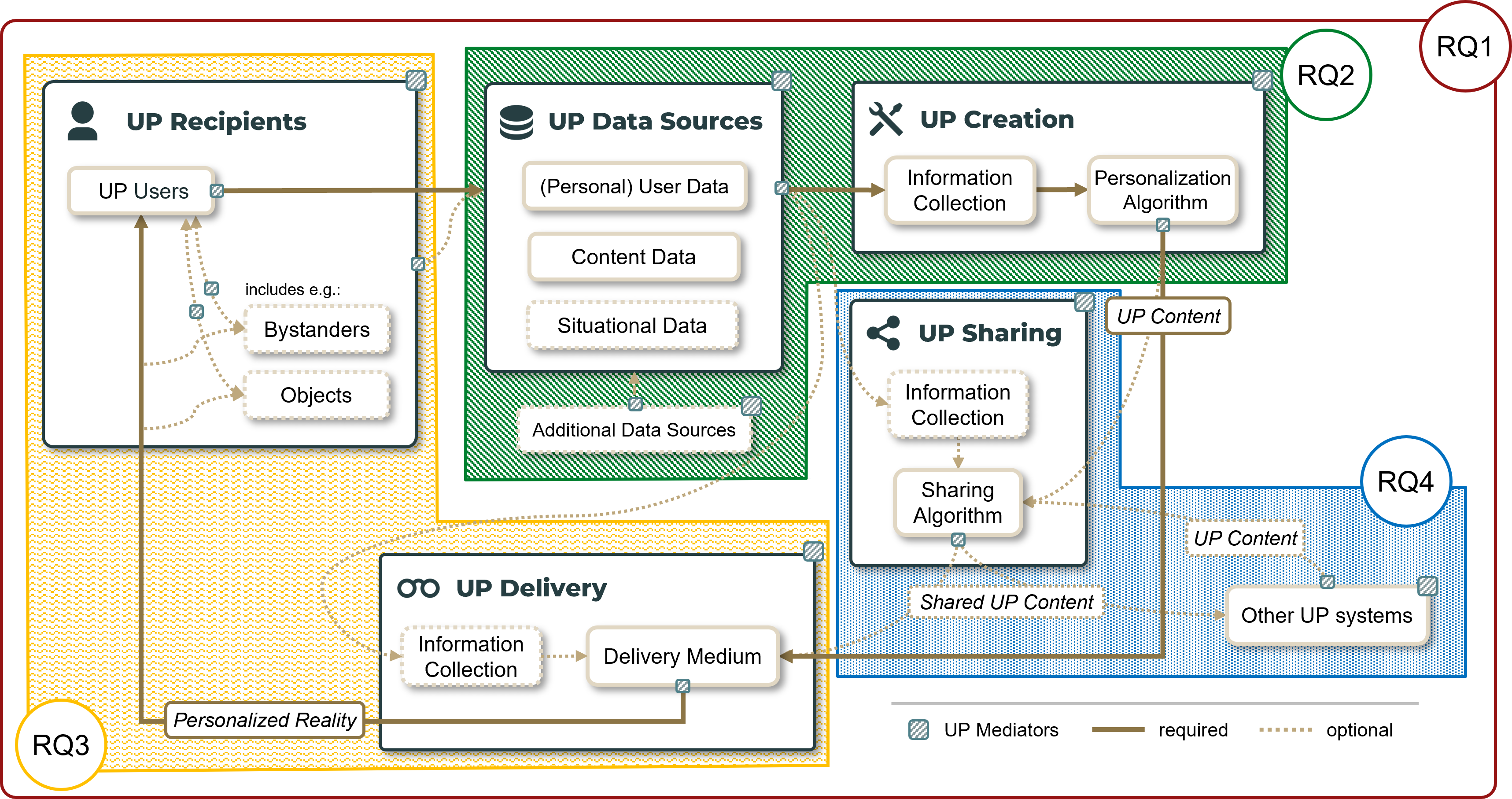
How can ubiquitous personalization systems be modeled to support the design, implementation and analysis of such systems in a responsible way?
Show Details
Abstract
Personalization of online realities is today ubiquitous to support decision making or reduce information overload. Recently, through the expanding capabilities and pervasiveness of Mixed Reality and Ubiquitous Computing technologies, we observe increasing personalization also of physical reality. This might yield more convenient, efficient and inclusive everyday interactions. However, it may readily lead to serious societal consequences such as the loss of shared worlds and the emergence of perceptual filter bubbles. To mitigate such harms while retaining the benefits of personalization, it is important to understand how ubiquitous personalization systems may operate responsibly. Responding to this need, we propose a conceptual model that overcomes the limitations of established personalization models and expands their applicable scope to physical, virtual, and hybrid environments. We validated our model in relation to existing literature and show how it provides a conceptual foundation for the analysis and study of responsible personalization systems that create individually and societally beneficial Personalized Realities.
Presentation
Download PresentationText Reference
Jannis Strecker, Simon Mayer, and Kenan Bektaş. 2025. Towards Societally Beneficial Personalized Realities: A Conceptual Foundation for Responsible Ubiquitous Personalization Systems. In Designing Interactive Systems Conference (DIS ’25), July 5–9, 2025, Funchal, Portugal. ACM, New York, NY, USA, 23 pages. https://doi.org/10.1145/3715336.3735709
BibTeX Reference
@inproceedings{10.1145/3715336.3735709,
author = {Strecker, Jannis and Mayer, Simon and Bekta\c{s}, Kenan},
title = {Towards Societally Beneficial Personalized Realities: A Conceptual Foundation for Responsible Ubiquitous Personalization Systems},
year = {2025},
isbn = {9798400714856},
publisher = {Association for Computing Machinery},
address = {New York, NY, USA},
url = {https://doi.org/10.1145/3715336.3735709},
doi = {10.1145/3715336.3735709},
abstract = {Personalization of online realities is today ubiquitous to support decision making or reduce information overload. Recently, through the expanding capabilities and pervasiveness of Mixed Reality and Ubiquitous Computing technologies, we observe increasing personalization also of physical reality. This might yield more convenient, efficient and inclusive everyday interactions. However, it may readily lead to serious societal consequences such as the loss of shared worlds and the emergence of perceptual filter bubbles. To mitigate such harms while retaining the benefits of personalization, it is important to understand how ubiquitous personalization systems may operate responsibly. Responding to this need, we propose a conceptual model that overcomes the limitations of established personalization models and expands their applicable scope to physical, virtual, and hybrid environments. We validated our model in relation to existing literature and show how it provides a conceptual foundation for the analysis and study of responsible personalization systems that create individually and societally beneficial Personalized Realities.},
booktitle = {Proceedings of the 2025 ACM Designing Interactive Systems Conference},
pages = {1792–1814},
numpages = {23},
keywords = {personalization, mixed reality, societal implications, mediated reality, conceptual model, responsible computing},
location = {
},
series = {DIS '25}
}
Teaser Video
Show Details
Abstract
The expanding capabilities of Mixed Reality and Ubiquitous Computing technologies enable personalization to be increasingly integrated with physical reality in all areas of people's lives. While such ubiquitous personalization promises more inclusive, efficient, pleasurable, and safer everyday interaction, it may also entail serious societal consequences such as isolated perceptions of reality or a loss of control and agency. We present this paper to initiate a discussion towards the responsible creation of ubiquitous personalization experiences that mitigate these harmful implications while retaining the benefits of personalization. To this end, we present the concept of Personalized Reality (PR) to describe a perceived reality that has been adapted in response to personal user data. We provide avenues for future work, and list open questions and challenges towards the creation of responsible PR experiences.
Text Reference
Jannis Strecker, Simon Mayer, and Kenan Bektaş. 2024. Personalized Reality: Challenges of Responsible Ubiquitous Personalization. In Proceedings of Mensch und Computer 2024 – Workshopband, Gesellschaft für Informatik e.V. (MuC'24). 5 pages. https://doi.org/10.18420/muc2024-mci-ws11-200
BibTeX Reference
@inproceedings{strecker2024a,
title = {{Personalized Reality: Challenges of Responsible Ubiquitous Personalization}},
booktitle = {Mensch Und {{Computer}} 2024 \textendash{} {{Workshopband}}},
author = {Strecker, Jannis and Mayer, Simon and Bekta{\c s}, Kenan},
year = 2024,
publisher = {{Gesellschaft f\"ur Informatik e.V.}},
doi = {muc2024-mci-ws11-200},
langid = {english}
}
RQ2
What are suitable ways to give humans transparency and agency over the flow of their personal data in resonsible ubiquitous personalization systems?
This RQ is still in progress. Papers that I have contributed to which are connected to this RQ:
Dogs Go Pods: Context-dependent Access Control Rules for Sharing Personal Data of Humans and Pets
ConferenceShow Details
Abstract
To advance self-determined data sharing, we present a novel paradigm for context-dependent access control for Solid, a specification for decentralized data stores (Pods) for secure sharing of personal data. Our approach enables dynamic, real-time updates to data access rights based on contextual information such as location, proximity, and behavior. Using Bluetooth Low Energy (BLE) beacons and a mobile application, we demonstrate our contribution in a pet ownership scenario, where a BLE-enabled dog collar manages access to a dog’s data Pod. For example, the owner’s contact details become publicly accessible if the pet runs away; access to vaccination records are made available to customs officials when the dog crosses a country border; and additional contact information for arranging play dates is made available to other dog owners when two dogs interact frequently. Our demonstrator highlights the potential of context-dependent access control rules to enhance data privacy in everyday IoT environments, taking advantage of contextual triggers that can reduce end-user complexity. We discuss applications beyond pet ownership and outline future work to refine our system’s usability and performance.
Text Reference
David Elia Egon Seger, Kimberly Garcia, Jannis Strecker-Bischoff, and Simon Mayer. 2025. Dogs Go Pods: Context-dependent Access Control Rules for Sharing Personal Data of Humans and Pets. In Companion of the the 2025 ACM International Joint Conference on Pervasive and Ubiquitous Computing (UbiComp Companion ’25), October 12–16, 2025, Espoo, Finland. ACM, New York, NY, USA, 5 pages. https://doi.org/10.1145/3714394.3754368
Show Details
Abstract
This paper introduces a novel system to enhance the spatiotemporal alignment of human abilities in agent-based workflows. This optimization is realized through the application of Linked Data and Semantic Web technologies and the system makes use of gaze data and contextual information. The showcased prototype demonstrates the feasibility of implementing such a system, where we specifically emphasize the system’s ability to constrain the dissemination of privacy-relevant information.
Text Reference
Jan Grau, Simon Mayer, Jannis Strecker, Kimberly Garcia, and Kenan Bektaş. 2024. Gaze-based Opportunistic Privacy-preserving Human-Agent Collaboration. In Extended Abstracts of the CHI Conference on Human Factors in Computing Systems (CHI EA ’24), May 11–16, 2024, Honolulu, HI, USA. ACM, New York, NY, USA, 7 pages. https://doi.org/10.1145/3613905.3651066
BibTeX Reference
@inproceedings{10.1145/3613905.3651066,
author = {Grau, Jan and Mayer, Simon and Strecker, Jannis and Garcia, Kimberly and Bektas, Kenan},
title = {Gaze-based Opportunistic Privacy-preserving Human-Agent Collaboration},
year = {2024},
isbn = {9798400703317},
publisher = {Association for Computing Machinery},
address = {New York, NY, USA},
url = {https://doi.org/10.1145/3613905.3651066},
doi = {10.1145/3613905.3651066},
abstract = {This paper introduces a novel system to enhance the spatiotemporal alignment of human abilities in agent-based workflows. This optimization is realized through the application of Linked Data and Semantic Web technologies and the system makes use of gaze data and contextual information. The showcased prototype demonstrates the feasibility of implementing such a system, where we specifically emphasize the system’s ability to constrain the dissemination of privacy-relevant information.},
booktitle = {Extended Abstracts of the 2024 CHI Conference on Human Factors in Computing Systems},
articleno = {176},
numpages = {6},
keywords = {Human-Agent-Collaboration, Koreografeye, Privacy-Preserving, Solid},
location = {Honolulu, HI, USA},
series = {CHI EA '24}
}
Teaser Video
RQ3
How can PR support humans transparently to efficiently navigate affordance-rich realities?
Show Details
Abstract
Board games often involve strategic decision making and procedural planning tasks. Such tasks require learners to make decisions based on dynamically evolving game state and changing information that is situated in a physical environment. Recommender systems can filter available information and provide learners with personalized and actionable suggestions that simplify their decision making while playing board games. Such recommendations can further be spatially aligned with relevant physical elements through Mixed Reality (MR). We present an MR system called GLAMRec for an engine-building strategy board game. GLAMRec provides personalized, transparent recommendations by integrating user data, real-time game state tracking, and ontology-based reasoning during a complex board game, which we use as a proxy environment for procedural learning tasks. We interviewed six board game designers to improve the GLAMRec and conducted a within-subjects design user study (N=32) to investigate how personalized explanations affect explanation satisfaction, user experience, and trust. We found that personalized recommendations significantly improve explanation satisfaction and hedonic user experience without affecting trust ratings, recommendation compliance, and game performance. These findings suggest that personalization primarily shaped perception of enjoyment rather than measurable learning outcomes or trust.
Text Reference
Sandra Dojcinovic, Jannis Strecker-Bischoff, Simon Mayer, and Kenan Bektaş. 2026. Personalized Recommendations in Mixed Reality Enhance Explanation Satisfaction and Hedonic User Experience in Board Game Learning. In 31st International Conference on Intelligent User Interfaces (IUI ’26), March 23–26, 2026, Paphos, Cyprus. ACM, New York, NY, USA, 20 pages. https://doi.org/10.1145/3742413.3789129
BibTeX Reference
@inproceedings{10.1145/3742413.3789129,
author = {Dojcinovic, Sandra and Strecker-Bischoff, Jannis and Mayer, Simon and Bekta\c{s}, Kenan},
title = {Personalized Recommendations in Mixed Reality Enhance Explanation Satisfaction and Hedonic User Experience in Board Game Learning},
year = {2026},
isbn = {9798400719844},
publisher = {Association for Computing Machinery},
address = {New York, NY, USA},
url = {https://doi.org/10.1145/3742413.3789129},
doi = {10.1145/3742413.3789129},
abstract = {Board games often involve strategic decision making and procedural planning tasks. Such tasks require learners to make decisions based on dynamically evolving game state and changing information that is situated in a physical environment. Recommender systems can filter available information and provide learners with personalized and actionable suggestions that simplify their decision making while playing board games. Such recommendations can further be spatially aligned with relevant physical elements through Mixed Reality (MR). We present an MR system called GLAMRec for an engine-building strategy board game. GLAMRec provides personalized, transparent recommendations by integrating user data, real-time game state tracking, and ontology-based reasoning during a complex board game, which we use as a proxy environment for procedural learning tasks. We interviewed six board game designers to improve the GLAMRec and conducted a within-subjects design user study (N=32) to investigate how personalized explanations affect explanation satisfaction, user experience, and trust. We found that personalized recommendations significantly improve explanation satisfaction and hedonic user experience without affecting trust ratings, recommendation compliance, and game performance. These findings suggest that personalization primarily shaped perception of enjoyment rather than measurable learning outcomes or trust.},
booktitle = {Proceedings of the 31st International Conference on Intelligent User Interfaces},
pages = {1263–1282},
numpages = {20},
keywords = {personalized learning, immersive learning, decision-support systems, board games},
location = {
},
series = {IUI '26}
}
Show Details
Abstract
Non-communicable diseases, such as obesity and diabetes, have a significant global impact on health outcomes. While governments worldwide focus on promoting healthy eating, individuals still struggle to follow dietary recommendations. Augmented Reality (AR) might be a useful tool to emphasize specific food products at the point of purchase. However, AR may also add visual clutter to an already complex supermarket environment. Instead, reducing the visual prevalence of unhealthy food products through Diminished Reality (DR) could be a viable alternative: We present Shopping-Coach, a DR prototype that identifies supermarket food products and visually diminishes them dependent on the deviation of the target product’s composition from dietary recommendations. In a study with 12 participants, we found that ShoppingCoach increased compliance with dietary recommendations from 75% to 100% and reduced decision time by 41%. These results demonstrate the promising potential of DR in promoting healthier food choices and thus enhancing public health.
Text Reference
Jannis Strecker, Jing Wu, Kenan Bektaş, Conrad Vaslin, and Simon Mayer. 2024. ShoppingCoach: Using Diminished Reality to Prevent Unhealthy Food Choices in an Offline Supermarket Scenario. In Extended Abstracts of the CHI Conference on Human Factors in Computing Systems (CHI EA ’24), May 11–16, 2024, Honolulu, HI, USA. ACM, New York, NY, USA, 8 pages. https://doi.org/10.1145/3613905.3650795
BibTeX Reference
@inproceedings{10.1145/3613905.3650795,
author = {Strecker, Jannis and Wu, Jing and Bekta\c{s}, Kenan and Vaslin, Conrad and Mayer, Simon},
title = {ShoppingCoach: Using Diminished Reality to Prevent Unhealthy Food Choices in an Offline Supermarket Scenario},
year = {2024},
isbn = {9798400703317},
publisher = {Association for Computing Machinery},
address = {New York, NY, USA},
url = {https://doi.org/10.1145/3613905.3650795},
doi = {10.1145/3613905.3650795},
abstract = {Non-communicable diseases, such as obesity and diabetes, have a significant global impact on health outcomes. While governments worldwide focus on promoting healthy eating, individuals still struggle to follow dietary recommendations. Augmented Reality (AR) might be a useful tool to emphasize specific food products at the point of purchase. However, AR may also add visual clutter to an already complex supermarket environment. Instead, reducing the visual prevalence of unhealthy food products through Diminished Reality (DR) could be a viable alternative: We present ShoppingCoach, a DR prototype that identifies supermarket food products and visually diminishes them dependent on the deviation of the target product’s composition from dietary recommendations. In a study with 12 participants, we found that ShoppingCoach increased compliance with dietary recommendations from 75\% to 100\% and reduced decision time by 41\%. These results demonstrate the promising potential of DR in promoting healthier food choices and thus enhancing public health.},
booktitle = {Extended Abstracts of the 2024 CHI Conference on Human Factors in Computing Systems},
articleno = {288},
numpages = {8},
keywords = {diminished reality, extended reality, food choices, health informatics, nutrition and health},
location = {Honolulu, HI, USA},
series = {CHI EA '24}
}
Teaser Video
Papers that I have contributed to which are connected to this RQ:
Show Details
Abstract
The number of deployed Internet of Things (IoT) devices is continuously increasing. While Mixed Reality (MR) allows hands-free interaction, creating MR User Interfaces (UI) for each IoT device is challenging, as often a separate interface has to be designed for each individual device. Additionally, approaches for automatic MR UI generation often still require manual developer intervention. To address these issues, we propose the JUIC-IoT system, which automatically assembles Just-in-Time MR UIs for IoT devices based on the machine-understandable format W3C Web of Things Thing Description (TD). JUIC-IoT detects an IoT device with object recognition, uses its TD to prompt an LLM for automatically selecting appropriate UI components, and then assembles a UI for interacting with the device. Our evaluation of JUIC-IoT shows us that the choice of LLM and the TD of a device are more crucial than the formulation of the input prompts for obtaining a usable UI. JUIC-IoT represents a step towards dynamic UI generation, thereby enabling intuitive interactions with IoT devices.
Text Reference
Lucien Ledermann, Jannis Strecker-Bischoff, Kimberly Garcia, and Simon Mayer. 2025. JUIC-IoT: Just-In-Time User Interfaces for Interacting with IoT Devices in Mixed Reality. In Companion of the the 2025 ACM International Joint Conference on Pervasive and Ubiquitous Computing (UbiComp Companion ’25), October 12–16, 2025, Espoo, Finland. ACM, New York, NY, USA, 7 pages. https://doi.org/10.1145/3714394.3754371
Ad-Blocked Reality: Evaluating User Perceptions of Content Blocking Concepts Using Extended Reality
ConferenceShow Details
Abstract
Inspired by the concepts of diminishing reality and ad-blocking in browsers, this study investigates the perceived benefits and concerns of blocking physical, real-world content, particularly ads, through Extended Reality (XR). To understand how users perceive this concept, we first conducted a user study (N=18) with an ad-blocking prototype to gather initial insights. The results revealed a mixed willingness to adopt XR blockers, with participants appreciating aspects such as customizability, convenience, and privacy. Expected benefits included enhanced focus and reduced stress, while concerns centered on missing important information and increased feelings of isolation. Hence, we investigated the user acceptance of different ad-blocking visualizations through a follow-up online survey (N=120), comparing six concepts based on related work. The results indicated that the XR ad-blocker visualizations play a significant role in how and for what kinds of advertisements such a concept might be used, paving the path for future feedback-driven prototyping.
Text Reference
Christopher Katins, Jannis Strecker, Jan Hinrichs, Pascal Knierim, Bastian Pfleging, and Thomas Kosch. 2025. Ad-Blocked Reality: Evaluating User Perceptions of Content Blocking Concepts Using Extended Reality. In CHI Conference on Human Factors in Computing Systems (CHI '25), April 26–May 01, 2025, Yokohama, Japan. ACM, New York, NY, USA, 18 pages. https://doi.org/10.1145/3706598.3713230
BibTeX Reference
@inproceedings{10.1145/3706598.3713230,
author = {Katins, Christopher and Strecker, Jannis and Hinrichs, Jan and Knierim, Pascal and Pfleging, Bastian and Kosch, Thomas},
title = {Ad-Blocked Reality: Evaluating User Perceptions of Content Blocking Concepts Using Extended Reality},
year = {2025},
isbn = {9798400713941},
publisher = {Association for Computing Machinery},
address = {New York, NY, USA},
url = {https://doi.org/10.1145/3706598.3713230},
doi = {10.1145/3706598.3713230},
abstract = {Inspired by the concepts of diminishing reality and ad-blocking in browsers, this study investigates the perceived benefits and concerns of blocking physical, real-world content, particularly ads, through Extended Reality (XR). To understand how users perceive this concept, we first conducted a user study (N = 18) with an ad-blocking prototype to gather initial insights. The results revealed a mixed willingness to adopt XR blockers, with participants appreciating aspects such as customizability, convenience, and privacy. Expected benefits included enhanced focus and reduced stress, while concerns centered on missing important information and increased feelings of isolation. Hence, we investigated the user acceptance of different ad-blocking visualizations through a follow-up online survey (N = 120), comparing six concepts based on related work. The results indicated that the XR ad-blocker visualizations play a significant role in how and for what kinds of advertisements such a concept might be used, paving the path for future feedback-driven prototyping.},
booktitle = {Proceedings of the 2025 CHI Conference on Human Factors in Computing Systems},
articleno = {626},
numpages = {18},
keywords = {Extended Reality, Content Curation, Visualization, Physical Ad Blocker},
location = {Yokhama, Japan},
series = {CHI '25}
}
Presentation Video
Show Details
Abstract
Head-mounted Augmented Reality (AR) displays overlay digital information on physical objects. Through eye tracking, they provide insights into user attention, intentions, and activities, and allow novel interaction methods based on this information. However, in physical environments, the implications of using gaze-enabled AR for human activity recognition have not been explored in detail. In an experimental study with the Microsoft HoloLens 2, we collected gaze data from 20 users while they performed three activities: Reading a text, Inspecting a device, and Searching for an object. We trained machine learning models (SVM, Random Forest, Extremely Randomized Trees) with extracted features and achieved up to 89.6% activity-recognition accuracy. Based on the recognized activity, our system—GEAR—then provides users with relevant AR feedback. Due to the sensitivity of the personal (gaze) data GEAR collects, the system further incorporates a novel solution based on the Solid specification for giving users fine-grained control over the sharing of their data. The provided code and anonymized datasets may be used to reproduce and extend our findings, and as teaching material.
Text Reference
Kenan Bektaş, Jannis Strecker, Simon Mayer, and Kimberly Garcia. 2024. Gaze-enabled activity recognition for augmented reality feedback. Computers & Graphics (March 2024), 103909. https://doi.org/10.1016/j.cag.2024.103909
RQ4
In a multi-user PR scenario, what are suitable, effective and usable methods to counter isolated perceptions of reality?
This RQ is still in progress. However, these vision papers sketch the basic ideas:
Show Details
Abstract
Enabled by advances in XR and AI, personalized services are increasingly affecting how individuals perceive, interact with, and navigate their realities. The resulting Personalized Realities (PR) may help people to interact more effectively with their surroundings, and allow more equitable access to information. However, PRs may also disconnect them from a collective understanding through isolated perceptions and perceptual filter bubbles. As democratic societies strive for social cohesion and shared knowledge and experiences, individual PRs may thus further add to existing social fragmentation. Yet, as PRs are framed as a concern that adapts experiences for a single user, they do not capture the full societal implications of a world where personalized mediation of reality is ubiquitous. In this paper, we therefore introduce the term Personalized Society (PSoc) to describe societies in which people predominantly access information and interact with others through a personalized mediation of reality. We discuss the duality of a PSoc, where personalization should be beneficial to the individual but at the same time connect people rather than isolate them. We identify key tensions arising in a PSoc and propose initial design considerations for fostering social cohesion alongside individual PRs, illustrating these through selected scenarios. Finally, we discuss the extent to which regulatory frameworks, such as the Digital Services Act, can be applied to protect individual and societal rights in a PSoc.
Text Reference
Jannis Strecker-Bischoff, Luka Bekavac, Simon Mayer and Kenan Bektaş. 2026. Connecting Personalized Realities: Challenges and Opportunities in a Personalized Society. In Proceedings of 1st Workshop on Shaping Future Human Connection: Social Augmentation through XR Technologies, co-colocated with the ACM CHI 2026 Conference (SAXR ’26). 15 pages
Show Details
Abstract
Extended Reality (XR) technologies enable the personalized mediation of an individual's perceivable reality across modalities, thereby creating a Personalized Reality (PR). While this may lead to individually beneficial effects in the form of more efficient, more fun, and safer experiences, it may also lead to perceptual filter bubbles since individuals are exposed predominantly or exclusively to content that is congruent with their existing beliefs and opinions. This undermining of a shared basis for interaction and discussion through constrained perceptual worldviews may impact society through increased polarization and other well-documented negative effects of filter bubbles. In this paper, we argue that this issue can be mitigated by increasing individuals' awareness of their current perspective and providing avenues for development, including through support for engineered serendipity and fostering of self-actualization that already show promise for traditional recommender systems. We discuss how these methods may be transferred to XR to yield valuable tools to give people transparency and agency over their perceptual worldviews in a responsible manner.
Text Reference
Jannis Strecker, Luka Bekavac, Kenan Bektaş, and Simon Mayer. 2025. Change Your Perspective, Widen Your Worldview! Societally Beneficial Perceptual Filter Bubbles in Personalized Reality. In Proceedings of Purposeful XR: Affordances, Challenges, and Speculations for an Ethical Future at CHI 2025 (Purposeful XR ’25). 6 pages. https://doi.org/10.48550/arXiv.2504.10271
BibTeX Reference
@misc{strecker2025changeperspectivewidenworldview,
    title={Change Your Perspective, Widen Your Worldview! Societally Beneficial Perceptual Filter Bubbles in Personalized Reality},
    author={Jannis Strecker and Luka Bekavac and Kenan Bektaş and Simon Mayer},
    booktitle={Proceedings of Purposeful XR: Affordances, Challenges, and Speculations for an Ethical Future at CHI 2025 (Purposeful XR ’25)}
    year={2025},
    eprint={2504.10271},
    archivePrefix={arXiv},
    primaryClass={cs.HC},
    url={https://arxiv.org/abs/2504.10271},
}
Show Details
Abstract
We are currently in a period of upheaval, as many new technologies are emerging that open up new possibilities to shape our everyday lives. Particularly, within the field of Personalized Human-Computer Interaction we observe high potential, but also challenges. In this article,we explore how an increasing amount of online services and tools not only further facilitates our lives, but also shapes our lives and how we perceive our environments. For this purpose, we adopt the metaphor of personalized ‘online layers’ and show how these layers are and will be interwoven with the lives that we live in the ‘human layer’ of the real world.
Text Reference
Eelco Herder, Laura Stojko, Jannis Strecker, Thomas Neumayr, Enes Yigitbas, and Mirjam Augstein. 2024. Towards new realities: implications of personalized online layers in our daily lives. i-com (June 2024). https://doi.org/10.1515/icom-2024-0017
BibTeX Reference
@article{herder2024,
title = {Towards New Realities: Implications of Personalized Online Layers in Our Daily Lives},
shorttitle = {Towards New Realities},
author = {Herder, Eelco and Stojko, Laura and Strecker, Jannis and Neumayr, Thomas and Yigitbas, Enes and Augstein, Mirjam},
year = {2024},
month = jun,
journal = {i-com},
publisher = {Oldenbourg Wissenschaftsverlag},
issn = {2196-6826},
doi = {10.1515/icom-2024-0017},
urldate = {2024-06-18},
abstract = {We are currently in a period of upheaval, as many new technologies are emerging that open up new possibilities to shape our everyday lives. Particularly, within the field of Personalized Human-Computer Interaction we observe high potential, but also challenges. In this article, we explore how an increasing amount of online services and tools not only further facilitates our lives, but also shapes our lives and how we perceive our environments. For this purpose, we adopt the metaphor of personalized `online layers' and show how these layers are and will be interwoven with the lives that we live in the `human layer' of the real world.},
langid = {english}
}
Show Details
Abstract
Nowadays, people encounter personalized services predominantly on the Web using personal computers or mobile devices. The increasing capabilities and pervasiveness of Mixed Reality (MR) devices, however, prepare the ground for personalization possibilities that are increasingly interwoven with our physical reality, extending beyond these traditional devices. Such ubiquitous, personalized MR experiences bring the potential to make our lives and interactions with our environments more convenient, intuitive, and safer. However, these experiences will also be prone to amplify the known beneficial and, notably, harmful implications of personalization. For instance, the loss of shared world objects or the nourishing of "real-world filter bubbles" might have serious social and societal consequences as they could lead to increasingly isolated experienced realities. In this work, we envision different modes for the sharing of personalized MR environments to counteract these potential harms of ubiquitous personalization. We furthermore illustrate the different modes with use cases and list open questions towards this vision.
Text Reference
Jannis Strecker, Simon Mayer, and Kenan Bektas. (2023). Sharing Personalized Mixed Reality Experiences. In P. Fröhlich & V. Cobus (Eds.): Mensch und Computer 2023 – Workshopband. 03.-06. September 2023. Rapperswil (SG). https://doi.org/10.18420/muc2023-mci-ws12-263
BibTeX Reference
@inproceedings{strecker2023a,
title = {Sharing {{Personalized Mixed Reality Experiences}}},
booktitle = {Mensch Und {{Computer}} 2023 \textendash{} {{Workshopband}}},
author = {Strecker, Jannis and Mayer, Simon and Bekta{\c s}, Kenan},
year = 2023,
publisher = {{Gesellschaft f\"ur Informatik e.V.}},
doi = {10.18420/muc2023-mci-ws12-263},
langid = {english}
}